Skip to content
If someone is planning a trip right now, they are not booking on impulse. They’re reading, comparing, and researching, often for weeks, before they ever click “book.” If your travel business isn’t showing up somewhere in that research window, you’re not losing to a better competitor. You’re losing to whoever simply showed up.
That’s the core problem digital marketing for travel companies solves: being visible, credible, and easy to book with at every point along a long, research-heavy decision. This guide walks through the channels that actually move bookings, what a small travel business should realistically budget, when to handle it yourself versus bring in outside help, and what’s changing now that travelers are starting to ask AI tools for recommendations instead of just Googling them.
Want the short version for your business? Book a free consultation and we’ll tell you exactly where your quickest wins are, no generic pitch, just a plan based on your site and your market.
Why Digital Marketing Works Differently for Travel Companies
Travel isn’t a one-click purchase. Booking a multi-day tour, a family vacation package, or a guided adventure trip is closer to buying a piece of furniture than ordering takeout. There’s real money on the line, real planning involved, and a research window that can stretch from a few days to several months depending on the trip.
That changes what marketing has to do. A travel marketing strategy needs to:
- Show up early, when someone is still deciding where to go, not just who to book with
- Build enough trust that a stranger feels comfortable handing over a deposit
- Stay present across that entire research window, not just at the final “ready to book” moment
There’s also a structural problem most travel businesses face: dependence on third-party platforms. OTAs (online travel agencies) like Viator, GetYourGuide, or Expedia drive bookings, but they typically take 20 to 30% commission and own the customer relationship, not you. Every dollar of marketing you invest in your own site and brand is a dollar that builds something OTAs can’t take back. (We’ve helped travel businesses tackle exactly this problem. Take a look at how we help travel companies generate direct bookings.)
The 5 Channels That Actually Drive Bookings
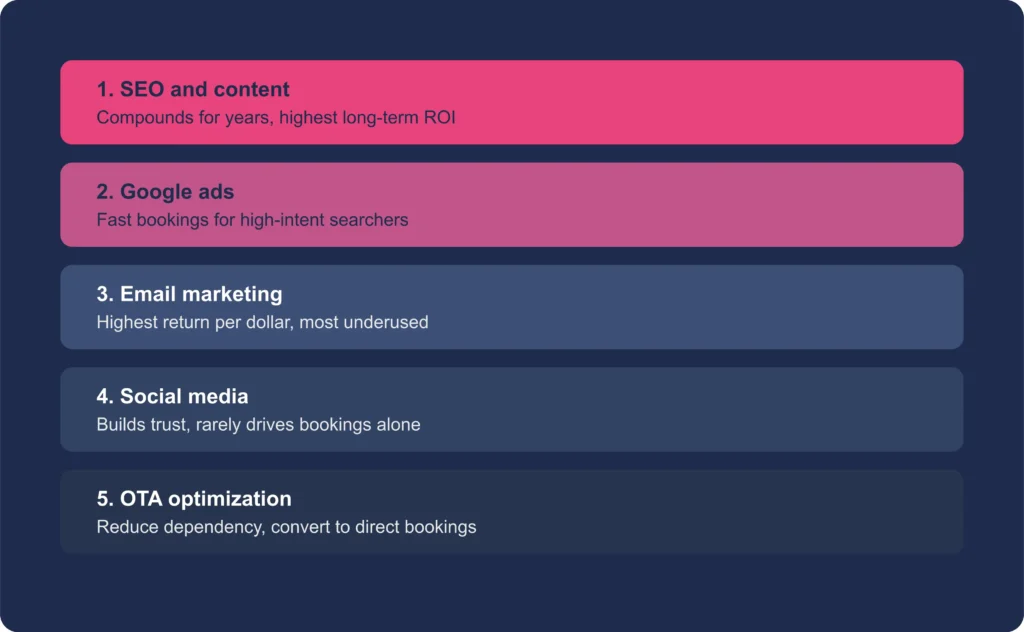
Not every channel deserves equal time or budget. Here’s how the main channels stack up for travel companies, roughly ranked by long-term return.
1. SEO & Content: Your Most Durable Asset
SEO for travel companies is the channel with the best long-term payoff, because a well-written piece of content can keep driving traffic for years after you publish it. A blog post about “Best Time to Visit [Destination]” or “What to Pack for a [Activity] Tour” can rank for a long time. A single social post, by contrast, is buried within a day or two.
Three keyword buckets matter most for travel businesses:
- Destination keywords: “things to do in [city],” “[destination] travel guide”
- Activity keywords: “best [activity] tours in [city],” “[activity] for beginners”
- Planning keywords: “best time to visit [destination],” “[destination] itinerary,” “what to wear on a [activity]”
Destination and planning keywords tend to have solid search volume and lower competition, because most smaller travel operators skip them entirely in favor of generic “book now” pages.
Technical basics still matter: page load under 3 seconds, mobile-friendly design (most travel searches happen on mobile), clean URLs, and a submitted XML sitemap. And because most travel businesses are inherently local or destination-tied, a fully filled-out Google Business Profile (complete fields, regular photos, fast review responses) is one of the highest-leverage things you can do for very little cost. This is the kind of groundwork our local SEO services are built around.
2. Google Ads: Fast Bookings, If You Target Well
If SEO is the long game, Google Ads is the fast lane. When someone searches “book a sunset sailing tour in Charleston,” they’re close to ready to buy, and a well-targeted ad captures that moment.
The catch: travel ad campaigns are easy to run badly. Bidding on broad terms like “Italy travel” attracts browsers, not bookers. The better approach is targeting specific, high-intent phrases, like “small group tours Italy” or “book [activity] in [city],” and sending that traffic to a dedicated landing page built around that exact offer, never your homepage. A reasonable benchmark is aiming for at least a 3:1 return on ad spend after the first 90 days of a properly managed campaign.
3. Email Marketing: The Most Underused Channel
Email consistently delivers one of the highest returns of any marketing channel, and travel is a good fit for it: your past customers have already shown they like what you sell, and the booking decision often takes weeks or months, plenty of time for a good nurture sequence to do its job.
Every website visitor, contact form submission, and past customer should land on your list. What actually works:
- Pre-trip emails that set expectations and reduce no-shows
- Post-trip review requests sent 24 to 48 hours after the experience
- Seasonal “what’s new” campaigns timed to your booking calendar
- A simple lead magnet, like a packing checklist or destination guide, to grow the list in the first place
Two to four emails a month tends to be the sweet spot. Generic “10% off” blasts with no context are the fastest way to get unsubscribed.
4. Social Media: Good for Trust, Not a Booking Engine on Its Own
Social media builds brand awareness and social proof, but it rarely converts into direct bookings by itself. Treat it as the layer that reassures someone who already found you through search or a referral, not your primary acquisition channel.
What tends to work: short-form video of real tour moments (raw footage usually outperforms polished content), reshared customer photos and reviews, and behind-the-scenes content that shows the people behind the experience. What doesn’t: spending hours perfecting posts that reach a tiny fraction of your audience, or treating social as a substitute for a real SEO and email strategy.
5. Reducing OTA Dependency
OTAs aren’t going away, and they’re a legitimate acquisition channel, but the smartest travel businesses treat them as a funnel into their own direct relationship, not a permanent home. A simple framework:
- Where your OTA’s terms allow it, collect email addresses from OTA bookings for post-trip communication
- Deliver an experience memorable enough that the customer remembers your brand, not the platform’s
- Offer a small, genuine incentive to book directly next time
- Make sure your own site’s pricing is never worse than what’s listed on the OTA
If a meaningful share of your revenue runs through OTAs at 20 to 30% commission, converting even a portion of repeat customers to direct bookings adds up fast. Our travel lead generation page walks through exactly this kind of direct-booking strategy in more depth.
AI Search Is Already Changing How Travelers Find You
A growing share of travelers are starting their research with an AI tool instead of a traditional Google search, asking things like “what are the best kayak tours in [city]” directly to an AI assistant. These tools tend to pull from content that’s clearly structured and directly answers specific questions, rather than vague brand copy.
Two practical things make a real difference here:
- Write content as direct answers. A clear FAQ section with specific, concrete questions (“How long is the [tour name] tour?” “What’s included in the price?”) is exactly the format AI tools tend to lift answers from.
- Use schema markup. Structured data (FAQ schema, and for tour-based businesses, schema types like
TouristTriporProduct) gives search engines and AI tools a clean, machine-readable summary of what you offer, rather than forcing them to interpret loosely-written paragraphs.
This doesn’t require an overhaul. It means writing your existing content a little more directly, and adding a few lines of structured markup behind the scenes, something most small travel sites haven’t done yet, which is exactly why it’s worth doing now.
What Should a Small Travel Business Actually Budget?
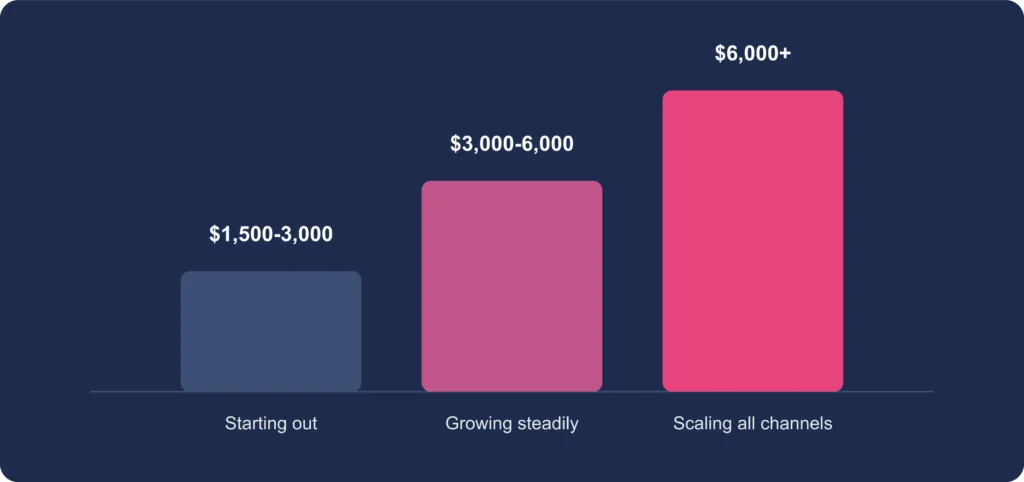
There’s no universal number, but here’s a realistic breakdown by stage, based on what each tier can actually support:
| Monthly Budget | What It Typically Covers | Best Fit For |
|---|---|---|
| $1,500 to $3,000 | Foundational SEO + Google Business Profile optimization, light content (1 to 2 posts/month), basic email setup | New or very small operators establishing a baseline online presence |
| $3,000 to $6,000 | Ongoing SEO + content (3 to 4 posts/month), managed Google Ads campaign, email automation, light social management | Established operators ready to actively grow bookings and reduce OTA dependency |
| $6,000+ | Full-channel management: SEO, Ads, email, social, plus conversion tracking and reporting across all of it | Multi-location or higher-volume operators with several revenue streams to optimize |
These are general industry ranges, not AmazeTech-specific pricing. Treat them as a starting point for your own conversation with whoever you work with. If you’d like a number tailored to your actual business, book a free consultation and we’ll put one together with you.
DIY vs. Hiring a Digital Marketing Agency: An Honest Framework
You don’t need an agency for everything, and you don’t need to do everything yourself either. Here’s a straightforward way to think about it.
DIY tends to make sense when:
- You’re in the very early stages and budget is tight
- You (or someone on your team) genuinely has the time to learn and execute consistently
- Your needs are simple: a Google Business Profile, a handful of social posts, basic email
Bringing in outside help tends to pay off when:
- Your time is better spent running tours and managing customers than learning SEO from scratch
- You need technical work done correctly the first time: proper schema markup, site speed fixes, a Google Ads campaign structured around real keyword intent
- You’ve tried DIY for a while and it’s plateaued, or you simply don’t have hours each week to give it
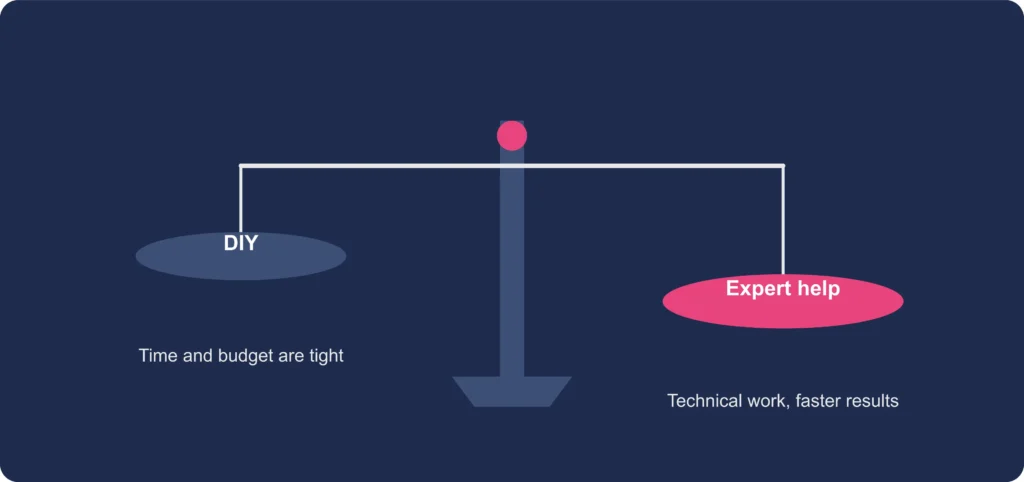
The honest answer for most small travel businesses is a hybrid: handle the things that take minutes (responding to reviews, posting a photo) yourself, and bring in expertise for the things that take real skill to do well, like technical SEO, ad management, and conversion-focused web design. That’s a more realistic split than either “do it all yourself” or “hand over everything.”
This is exactly where AmazeTech fits in for travel businesses that want the technical side handled right. Our SEO services cover the technical and content groundwork this guide walks through, and our development team can rebuild a slow, outdated travel site into something that actually converts. If you’re not sure which side of this split makes sense for your business, schedule a free call and we’ll help you figure it out, no pressure either way.
What Real Results Can Look Like
Numbers vary by business and starting point, but here’s a sense of what’s achievable with a focused digital marketing push: AmazeTech’s work with Pamlico Solar, a different vertical, but a comparable full-stack engagement covering website, SEO, paid ads, and content, produced a 45% increase in organic search traffic within six months and a 50% increase in qualified leads from digital ads over the same period. The same channel mix and sequencing (get the site and tracking right first, then layer in content and paid traffic) applies directly to a travel business working to build direct bookings instead of relying on OTAs.
For a travel-specific example, take a look at our Indus Travels case study to see how this plays out for a business in your own industry.
[Note for internal review: this section should be updated with specific Indus Travels case study numbers once pulled from the live case study page. Currently using a verified cross-vertical example to avoid citing unconfirmed figures.]
Getting Started: A 90-Day First-Steps Checklist
If you’re starting from zero, here’s a realistic order of operations:
- Weeks 1 to 2: Claim and fully complete your Google Business Profile; audit your site for mobile speed and basic SEO issues
- Weeks 3 to 4: Set up email capture on every page and booking confirmation; write your first 2 pieces of destination/planning content
- Weeks 5 to 8: Launch a small, tightly targeted Google Ads campaign on your highest-intent search terms; build your first FAQ section with schema markup
- Weeks 9 to 12: Review what’s working using real data (which content is getting traffic, which ads are converting) and double down on it
This is also the point where many travel businesses realize which parts they want to keep doing themselves and which parts they’d rather hand off. If that’s you, get in touch and we’ll help you map out the next 90 days.
Frequently Asked Questions
What is digital marketing for travel companies? It’s the use of SEO, content, paid advertising, email, and social media to help travel businesses (tour operators, travel agencies, and activity providers) get found by travelers during their research phase and convert that attention into direct bookings.
How much should a travel company spend on marketing? It depends on stage and goals, but a useful starting range for small operators is $1,500 to $6,000/month, scaling up with the channel mix and volume of content or ad management involved. See the budget table above for a fuller breakdown.
Do travel agencies need social media? Social media helps build trust and brand awareness, but it rarely drives bookings directly on its own. It works best as support for a stronger SEO and email strategy, not as a replacement for one.
How long does SEO take to work for a travel business? Most travel businesses start seeing meaningful organic traffic gains in 3 to 6 months, with results compounding from there as more content gets published and existing pages mature in the rankings.
Should I hire an agency or do my own marketing? It depends on your time and the complexity of what you need. Simple, ongoing tasks (review responses, occasional posts) are reasonable to DIY. Technical work that’s easy to get wrong, like SEO fundamentals, ad campaign structure, and conversion-focused website design, is usually worth bringing in expertise for, especially if your time is better spent running the business itself.
Ready to Turn Travelers Into Bookings?
Whether you need a full strategy or just want a second opinion on what’s working and what isn’t, we’re happy to help. Get My Free Growth Plan and we’ll show you exactly where the opportunity is for your travel business, or schedule a free consultation call if you’d rather talk it through directly.