Hiring a web development agency is a decision most small business owners make maybe twice a decade, which means most people making it have never really practiced. Meanwhile the agencies pitching you do this every day and know exactly which words make a generic package sound custom. This guide is the framework to close that gap: what actually separates a good web development agency from a bad one, what a website should cost, and the specific mistakes that cost small businesses the most money and time.
Quick answer: what to look for in a web development agency
A web development agency worth hiring should be able to show you, without hedging: real live small-business sites they built (not mockups), a clear answer for how they design for conversion rather than just appearance, real page speed and Core Web Vitals numbers from past work, a straight answer on what happens after launch, and whether SEO and AI-search visibility are built in from day one or sold as a separate add-on later. If an agency cannot answer all five clearly, keep looking.
| If you want to skip the vetting process, AmazeTech builds small business websites around exactly this framework as a matter of course. Otherwise, here is how to apply it yourself. |
What does a good web development agency actually do differently?
Most agencies will build you something that looks like a website. Far fewer build something engineered to turn a visitor into an inquiry. The difference comes down to five things happening together, not in isolation.
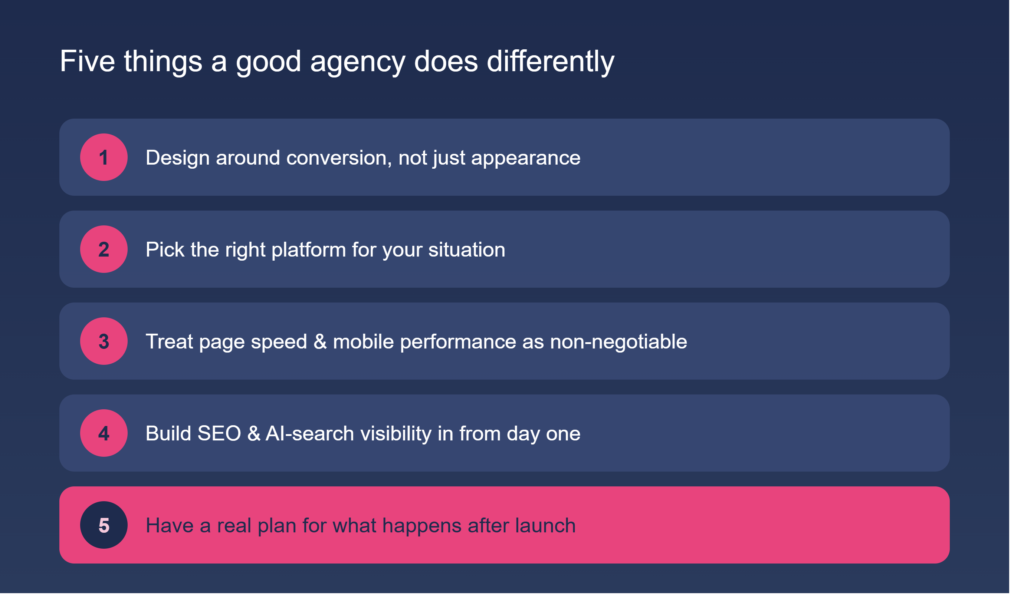
1. They design around conversion, not just appearance
A homepage can look polished and still have no clear next step for the visitor. Ask any agency you are evaluating to explain, specifically, how a first-time visitor gets from landing on your homepage to filling out a form or picking up the phone. If the answer is vague (“we’ll make it look great”), that is a sign the site will be beautiful and unproductive. AmazeTech treats this as a core requirement of every website development project, not an afterthought layered on after design is finished.
2. They pick the right platform for your situation, not their default
Most small business sites run on WordPress for good reason: flexibility, a massive plugin ecosystem, and no vendor lock-in to a single company’s platform. Some agencies default to WordPress regardless of fit; others push a proprietary builder that locks you into their hosting and support forever. Ask directly why they are recommending a given platform for your specific business, and be wary of an answer that boils down to “it’s what we always use.” AmazeTech’s WordPress development and broader CMS development work starts from what the business actually needs, including e-commerce development for businesses that need to sell online.
3. They treat page speed and mobile performance as non-negotiable
A slow site loses visitors before they ever see your offer, and it loses rankings in both Google and AI-generated answers. Ask for real Core Web Vitals scores from sites the agency has actually shipped, not a generic promise that “we optimize for speed.”
4. They build SEO and AI-search visibility in, not bolt it on later
A site built with no attention to SEO or AI-search discovery almost always needs expensive rework once the business realizes nobody can find it. A growing share of research now happens inside ChatGPT, Gemini, and Google’s AI Overviews before a person visits a website directly, so a technically sound foundation increasingly determines whether you show up in an AI-generated answer at all, not just a traditional search result.
5. They have a real plan for what happens after launch
A website is not a one-time project. Ask exactly who handles updates, security patches, and content changes once the site goes live, and what that costs on an ongoing basis. Agencies that go quiet after the invoice clears are a common complaint among small business owners who have been through this before.
What should a small business website actually cost?
Pricing varies with scope, but here is a realistic range for 2026, so you can spot an outlier in either direction.
| Project type | Typical range | What drives the cost |
| Simple brochure site (5–8 pages) | $2,000–$6,000 | Custom design vs. template, content volume |
| Full small business site with SEO foundation | $6,000–$15,000 | Custom development, SEO setup, integrations |
| E-commerce site | $8,000–$25,000+ | Product catalog size, payment/inventory integration |
| Ongoing maintenance and updates | $100–$800/month | Hosting, security, content changes, support level |
Be cautious in both directions. A quote far below these ranges usually means a heavily templated build with little SEO or conversion thinking behind it. A quote far above, especially for a straightforward small business site, deserves a clear explanation of what the extra cost is buying. If you want a specific number for your situation, AmazeTech prices its website development work for startup and SMB budgets rather than enterprise retainers.
WordPress vs. website builder vs. custom development: which fits your business?
| Factor | Website builder (DIY) | WordPress (agency-built) | Fully custom development |
| Upfront cost | Lowest | Moderate | Highest |
| Flexibility | Limited to platform templates | High, large plugin ecosystem | Unlimited |
| SEO control | Limited | Strong | Strong |
| Growth headroom | Low, hits limits quickly | High | Highest |
| Best for | Very simple sites, no growth plans | Most small businesses | Complex or highly custom needs |
For most small businesses, agency-built WordPress sits in the sweet spot: far more capable than a DIY builder, without the cost and timeline of a fully custom build from scratch. AmazeTech builds on this middle path through its website development and WordPress development services.
Red flags: mistakes that cost small businesses the most
- No live examples, only mockups or a generic portfolio PDF. Ask to see actual small business sites they built, and check that those sites still work well today.
- Vague answers about conversion. If nobody on the call can explain how the site turns visitors into inquiries, the site probably will not either.
- No mention of page speed or mobile performance until you ask. This should be a default topic, not something you have to pull out of them.
- SEO positioned as a separate upsell after launch. This usually means expensive rework later, once the business realizes the new site is not being found.
- No clear answer on post-launch support. Find out before you sign, not after the site breaks.
- Pricing that seems too good to be true. It usually means a heavily templated build, not a strategic one.
A five-question script for your first agency call
Bring these five questions to every discovery call. The quality of the answers, not just the content, tells you most of what you need to know.
- Can you show me two or three live small business sites you built, and what results they’ve seen?
- How does this site specifically turn a visitor into a call or a form submission?
- What are your typical page speed and Core Web Vitals numbers on completed projects?
- Is SEO and AI-search visibility included in this project, or a separate phase?
- What does support look like in month two, six, and twelve after launch?
| If you want to skip straight to a team that already answers all five clearly, book a free consultation with AmazeTech and bring your current site, or lack of one, to the call. |
Frequently asked questions
How do I know if a web development agency is any good?
Ask for live examples of small business sites they have built, confirm they can explain their approach to conversion (not just design), and check real page speed and Core Web Vitals numbers from past work rather than accepting vague promises.
How much should a small business website cost in 2026?
A simple brochure site typically runs $2,000 to $6,000, a full small business site with SEO built in runs roughly $6,000 to $15,000, and e-commerce sites often start around $8,000 and scale with catalog size and integrations. Ongoing maintenance usually runs $100 to $800 per month depending on scope.
Is WordPress still a good choice for a small business website in 2026?
Yes. WordPress remains one of the most flexible and widely supported platforms for small business sites, offering a large plugin ecosystem and no vendor lock-in, which makes it a strong middle ground between a limited DIY builder and a fully custom build.
What is the biggest mistake small businesses make when hiring a web developer?
The most common and costly mistake is hiring based on price or portfolio looks alone without confirming the agency designs specifically for conversion and builds in SEO and AI-search visibility from the start, both of which are expensive to add after the fact.
Should I hire an agency or a freelancer for my small business website?
A freelancer can work well for a narrow, well-defined task, but rarely covers design, development, SEO, and ongoing support together. A full-service agency typically covers that entire path under one roof, which is usually more reliable for a small business without an internal marketing or development team.
| Want a website evaluated against this exact framework, free? Contact AmazeTech or book a free consultation and we’ll walk through where your current site stands. |